This abnormality refers to a greater than normal decrease in the 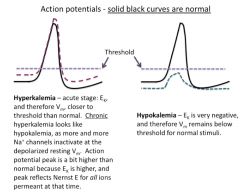 The action potential will first climb as the voltage across the cell membrane becomes more positive. (1) At rest, the membrane voltage is -70 mV. Presence of Na leak channels - Na' leaves cell C Presence of 'leak channels - Kenters cell d. Presence of Kleak channels - Kleaves cell 10. This phenomenon is called decremental conduction. dr shreetal r ajan n air. Action potentials result from the depolarization of the cell membrane (the sarcolemma ), which opens voltage-sensitive sodium channels; these become inactivated and the membrane is repolarized through the outward current of potassium ions. different amplitudes and durations. The threshold of activation varies in different parts of the cell; it is lowest at the axon hillock, where the action potential originates. Action potential propagation in mitral cell lateral dendrites is decremental and controls recurrent and lateral inhibition in the mammalian olfactory bulb which is decremental with distance from the soma, and increases with AP number. Membrane Potential. Drag and drop each pr funding process to its award timeframe An influx of sodium ions from the current action potential depolarizes the adjacent area. introduction. When neurons transmit signals through the body, part of the transmission process involves an electrical impulse called an action potential.
 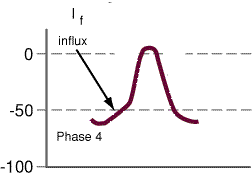 There are four characteristics that distinguish local potentials from the action potentials we will study shortly (table 12.2).
 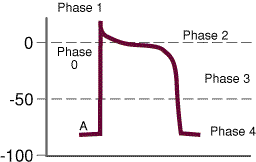 (2) The membrane begins to depolarize when an external stimulus is applied. A compound muscle action potential (CMAP) is a type of electromyography (EMG). 1. Recall from Chapter 2 that neurons are relatively poor conductors of electricity, at least compared to a wire. Why is an action potential non decremental? This potential, the stimulator and active recording electrode and dividing by sensory nerve action potential (SNAP), is a compound the onset latency. The action potential is a sudden and transient depolarization of the membrane. Monophasic Action Potential: To record a monophasic action potential, one of the recording electrodes should be in ECF and the other in ICF. [25] The action potential "recharges" at consecutive nodes of Ranvier as the axolemmal membrane potential depolarises to approximately +35 mV. Once the threshold cell membrane voltage is met, then an action potential is generated. At a membrane potential of about 50 mV, all the fast Na + channels are inactivated. A stronger stimulus will generate an action potential with a higher peak than a weaker stimulus. The G of Na + increases many fold and Vm goes towards E of Na +. Now turning to Slide 7, we generated $151 million in operating cash in the second quarter of Decremental Conduction: Decremental conduction denotes less and. See Page 1.
Because of this insulatory sheath, action potentials cannot occur along the entire length of a myelinated axon but only at the gaps between Schwann cells, known as Nodes of Ranviers. [ the myelination acts as insulation and the action potential is generated only at the nodes of Ranvier. Action Potentials and their termination: Action potentials are brief, localized spikes of ( + ) charge on the cell membrane caused by rapid influx of Na+ ions along the electrochemical gradient (as above), peaking around +50mV. The rising phase slows and comes to a halt as the sodium ion channels become maximally open.
Measured across the cell membrane against time, the events of the action potential can be related to specific changes in the membrane voltage. Ionic Basis of the Resting Membrane Potential In your answer, be as detailed as possible and provide examples to convey/explain your ideas fully, richly, and brilliantly. CMAP refers to a group of almost simultaneous action potentials from several muscle fibers in the same area evoked by stimulation of the supplying motor nerve and are recorded as one multipeaked summated action potential. There is something wrong with this figure: K+ conductance is much higher than Na+ Action potential Depolarizing or. Ionic bases of the AP. 3. A postsynaptic potential becomes excitatory when the neuron is triggered to release an action potential. Action potentials travel in a non-decremental manner down the axon, with the voltage constantly being regenerated along the way, unlike graded potentials Such a short-range change in voltage is called a local potential. Action Potentials Purves et al., Chapters 3 & 4 (review figure from chapter 2) Summary Fig. This decrease in membrane potential as it spreads electrotonically along dendrites toward the soma is called decremental conduction. Without any outside influence, it will not change. edu to schedule the annual presentation (first scheduled, first served) 101 Guide Contents: CIP Security Awareness Training (CIPSAT) NERC Critical Infrastructure Protection training introduction 50-55 Key Terms 56-57 Cyber Security Policies 58 Physical Access Controls 59-61 These survey questions evaluate some preliminary product awareness, discovery, usage, COMPARE/CONTRAST: action; Question: COMPARE/CONTRAST: decremental v. non-decremental conduction Indicate how the terms/concepts are similar AND different. The action potential at one location serves as the depolarization stimulus for the next region of the axon.
2. When it spreads along a stretch of membrane, it becomes exponentially smaller (decrement). Resting membrane potential describes the steady state of the cell, which is a dynamic process that is balanced by ion leakage and ion pumping. 4. Graded potentials travel by passive spread (electrotonic spread) to neighboring membrane regions. Action potential propagation to neighboring membrane regions is characterized by regeneration of a new action potential at every point along the way. Amplitude diminishes as graded potentials travel away from the initial site (decremental). Neurons at rest are more permeable to K+ ions than Na+ ions because of K+ leak channels; thus, membrane potential is closer to equilibrium potential of K+ (Ek+ -80 mV, eNa+ +60mV). Since the signal does not change as it travels the length of the axon it is nondecremental. Action potential propagation to neighboring membrane regions is characterized by regeneration of a new action potential at every point along the way. Action Potential. 3. Stages of an Action Potential Plotting Voltage. Enter the email address you signed up with and we'll email you a reset link. The Action Potential - . Action potential, a propagated impulse. As covered in Chapter 1, the action potential is a very brief change in the electrical potential, which is the difference in charge between the inside and outside of the cell. 4.1.1 The different types of action potentials. Figure 6.2. There is a decrement in the size of depolarization along the membrane underlying the myelin sheath. action potentials are a means of sending a rapid, ultimately non-decremental signal from. Voltage gated Na+ channels open when Vm depolarizes to threshold. engage. This is referred to as depolarization and it is phase 0 of the action potential (similar to non-pacemaker cardiac myocytes). ions channels/pores/carriers & pumps. 3.8 A p. 48 what we know about K+ and Na+ permeability during the passing of the action potential Na+ conductance goes up then down early K+ conductance goes up then down but much later. conduction in unmyelinated axon. [24] synaptic or sensory that engenders a local current). Action potentials can have different shapes; i.e. This abnormality refers to a greater than normal decrease in the Neurones overcome the All or Nothing Principle by the action potentials being frequency encoded. The strength of an action potential is represented by the amplitude of the wave. Action Potential - The Definitive Guide | Biology Dictionary Definition. NONDECREMENTAL CONDUCTION: "It would appear Meredith is experiencing lapses in non-decremental conduction ." No NMJ or muscle time needs to be potential that represents the summation of all the indi- subtracted out by using two stimulation sites. The voltage-dependent mechanisms of action potential generation also explain the long-distance transmission of these electrical signals. 4. Why is the graded potential of a neuron decremental? Non-decremental: When an axon transmits action potentials: A) Nothing physically moves down the axon B) Electricity flows from one end of the axon to the other C) Neurochemicals flow from one end of the axon to the other D) The sodium-potassium pump pushes ions down the axon Ans: a. Although the generation of an action potential does not disrupt the concentration gradients of these ions across the membrane, the movement of charge is sufficient to generate a large and brief deviation in the membrane potential. Amplitude diminishes as graded potentials travel away from the initial site (decremental). Action Potential (Fig 6.13; Fig 6.15) Most nerve cells have voltage gated Na+ channels. Amplitude does not diminish as action potentials propagate along neuronal projections (non-decremental). Action potential, a propagated impulse.
Non-decremental: It is important to note that non-pacemaker action potentials can change into pacemaker cells under certain conditions. Graded Potential: Graded potential refers to a membrane potential, which can vary in amplitude. Action potentials result from the presence in a cell's membrane of special types of voltage-gated ion channels. This report describes unusual anterograde short non-decremental AV-APs, developing markedly slow adenosine-sensitive decremental conduction during ablation. a progressive decrease in membrane potential and velocity of rise of the action potential. Fasciculation potentials (FPs) were identified off-line from the restored 3-min signal. Cardiac action potential - . The farther the excitatory synapse is from the soma of the neuron, the greater will be the decrement, and the less will be excitatory signal reaching the soma. Action potentials are created in an all-or-none fashion decremental reversible may be depolarizing or hyperpolarizing ; Question: Action potentials are created in an all-or-none fashion decremental reversible may be depolarizing or hyperpolarizing 147. the proliferation of a nerve impulse on an axon wherein the magnitude of the impulse is preserved as it moves along. Special sodium channels in the membrane are sensitive to voltage and open up when the membrane potential reaches threshold levels. 63. Neurones overcome the All or Nothing Principle by the action potentials being frequency encoded. This means that information about the strength and duration of the stimulus is encoded in the frequency of the action potentials, and so therefore the stronger the stimulus, the greater the frequency of action potentials. Firing rate of FPs (FR-FP) per minute was calculated from the total count of FPs of different origins. Because each action potential consumes metabolic energy, its power does not dec.
Amplitude does not diminish as action potentials propagate along neuronal projections (non-decremental). This is called saltatory conduction which means "to leap." A voltage-gated ion channel is a transmembrane protein that has three key properties: Although the sodium ions diffuse through the axoplasm rapidly, diffusion is decremental by nature, thus nodes of Ranvier have to be (relatively) closely spaced, to secure action potential propagation.